Association website design and development: A 2026 guide
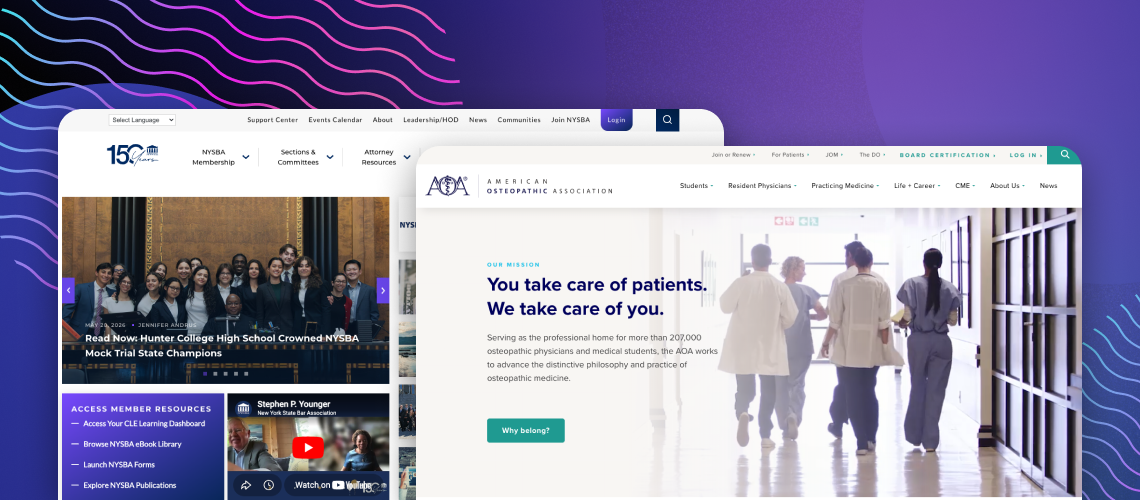
Engineering durable digital platforms that drive member retention, recruitment, and industry authority through Answer Engine Optimization (AEO).
Association website design in 2026 demands platforms that handle AMS data, gated member portals, and AI-powered search without breaking on launch. Clique Studios helps professional associations and trade organizations transform fragmented legacy systems into member-centric digital experiences. We drive measurable outcomes-including increased member acquisition and reduced support overhead-by bridging the gap between deep technical integrations and intuitive UX. With over a decade of experience serving major organizations like the NYSBA and AOA, we've built association websites that hold up under daily AMS sync, large-scale content migrations, and AI-powered search load.
Who are the best association web design agencies?
Key Takeaways: The best association web design agencies fall into three categories: legacy AMS-first shops, aesthetic-first creative firms, and experience engineering firms. Legacy association agencies know dues data deeply but ship dated interfaces, while creative firms produce attractive sites that buckle under AMS integration load. Experience engineering firms like Clique Studios combine deep AMS integration with member-centric UX, AEO content strategy, and large-scale migration work.
For an association, your website is your primary service delivery platform. When vetting partners, most organizations find themselves choosing between three distinct philosophies:
The Legacy Incumbents (AMS-First Shops) These are the agencies that have lived in the association space for decades. They speak the language of dues and renewals fluently and often have proprietary integrations with major AMS platforms like Personify and Salesforce. The Tradeoff: Innovation debt. Because they are built on legacy frameworks, their designs often feel dated and their user experiences can be clunky. They prioritize "making the data fit" over the actual Member Experience (MX).
The Aesthetic Generalists (Creative-First Firms) These are high-end design boutiques that build beautiful, award-winning sites for lifestyle brands or B2B tech. They will make your association look polished, sleek, and prestigious. The Tradeoff: Technical fragility. Associations are data-heavy ecosystems. These firms often underestimate the complexity of a Salesforce sync or a 40,000-page migration (like we handled for the NYSBA). You end up with a beautiful site that breaks the moment a member tries to access a gated portal.
The Experience Engineers (Clique Studios) This is where Clique Studios sits. We believe an association website should be as intuitive as a consumer app and as durable as an enterprise database. We don't just "skin" an AMS; we engineer a cohesive digital journey.
Our Approach: We bridge the gap. We combine the deep technical rigor needed for advanced integrations (Algolia, Personify, SSO) with a performance-first mindset (AEO and CRO).
The Result: We help organizations like the American Osteopathic Association and the New York State Bar Association move past "standard functionality" to create digital platforms that drive recruitment and demonstrate membership ROI to the board.
The right choice depends on your internal priority: Are you looking for a safe "industry-standard" build, a visual-only refresh, or a strategic digital transformation that turns your website into your most valuable member benefit?
Why are association websites different?
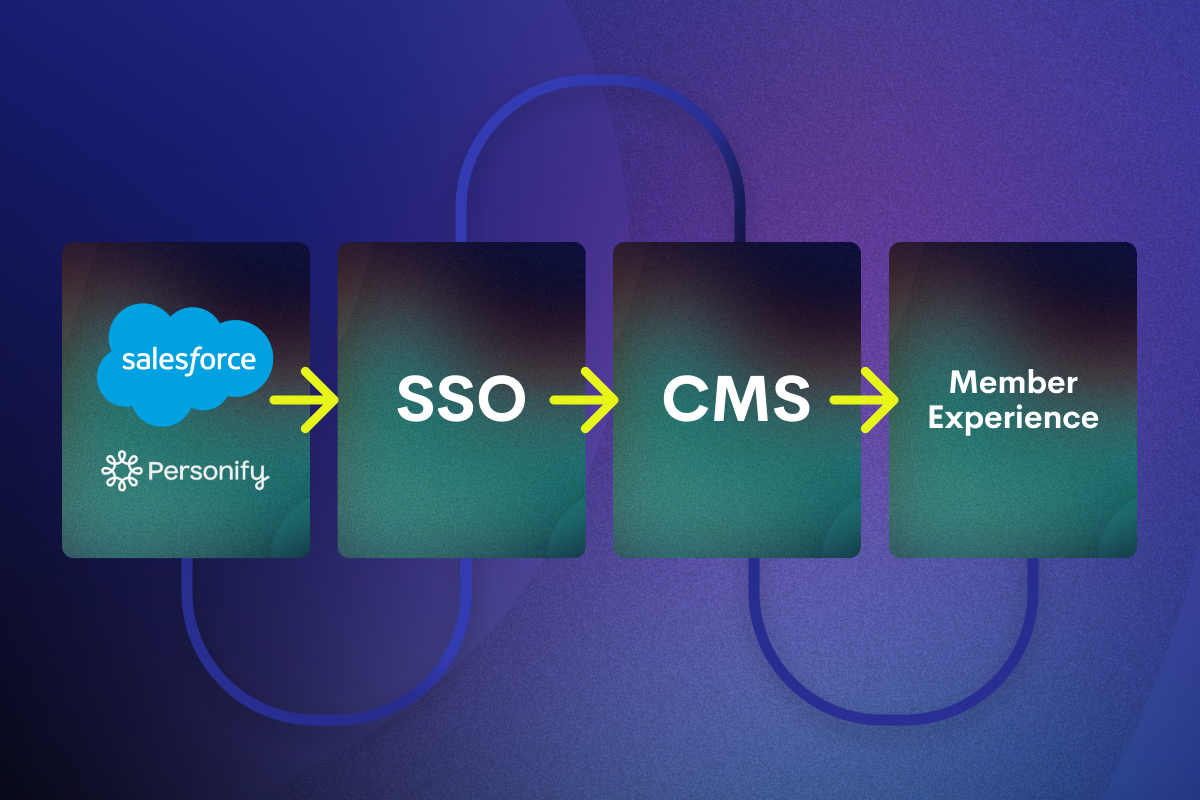
Key Takeaways: Association websites differ from consumer or B2B sites by serving two distinct audiences at once: prospective members in marketing mode and current members managing dues and CE credits. Tight integration with the AMS - Personify, Salesforce, or iMIS - is foundational, since a broken SSO connection breaks the association member experience immediately. Association websites also surface decades of archived research and standards that members and competitors treat as the authoritative source in the industry.
Association websites are uniquely demanding ecosystems that must balance institutional stability with modern digital expectations. In 2026, the stakes are higher than ever:
The information overload paradox: Associations own the most valuable data in their industries - decades of research, standards, news, and historical content. The challenge is surfacing it. Unlike B2B sites that curate around a single product line, association websites must make thousands of pages instantly discoverable. This is why federated search platforms like Algolia have become standard on serious association builds: a member typing "malpractice" should get a research paper, a CLE course, and an ethics opinion in one type-ahead pass.
Dual-Persona Journeys: A site must simultaneously act as a high-conversion marketing landing page for prospective members and a single-step tool for existing ones (dues, CE credits, networking). These two journeys rarely overlap, which is why role-based content disclosure - serving "Why Join" prompts to unauthenticated visitors and member-only resources to logged-in users - has become foundational.
Data Interoperability: A website is only as strong as its connection to the AMS (Association Management System). If the SSO (Single Sign-On) or CRM sync (Salesforce, Personify, or iMIS) fails, the member experience breaks immediately. We treat AMS integration not as a feature but as a foundational layer, with fail-safe API mapping that keeps the website functional even when the AMS or a third-party database experiences a lag.
Our experience with associations
We have a proven history of managing high-complexity builds for some of the nation's most prestigious organizations.
New York State Bar Association (NYSBA)
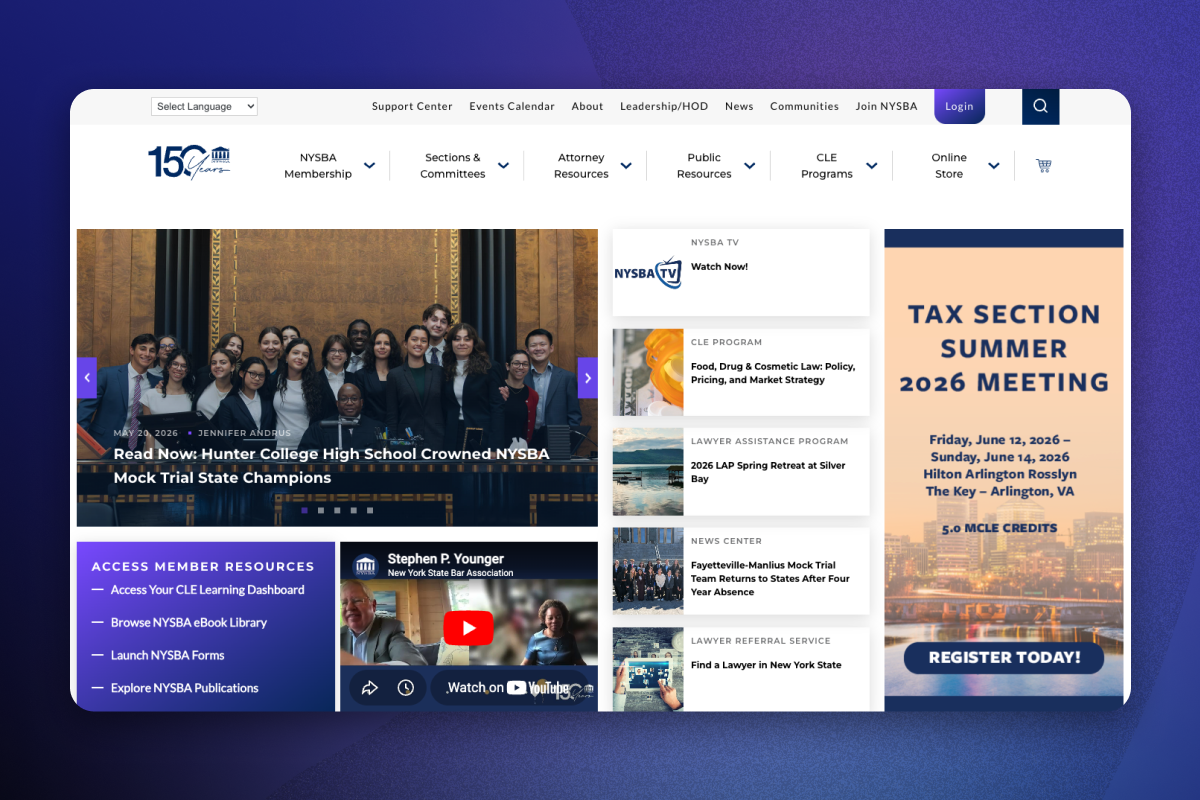
The Work: A digital transformation featuring 43,000 legacy redirects and a daily Salesforce integration for event and member data.
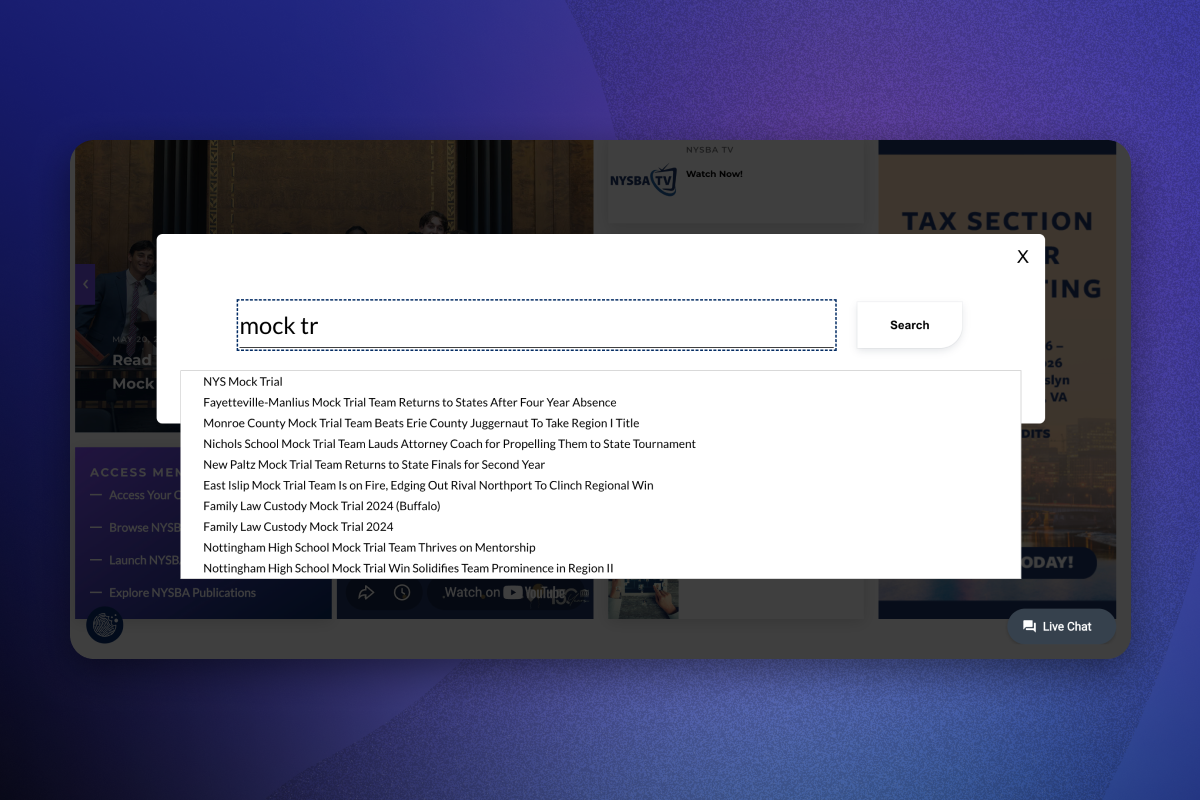
Outcome: Implemented Algolia Federated Search, allowing members to search across the site and external databases with AI-powered "type-ahead" accuracy - built on insight from 38 stakeholder interviews across 12 departments.
American Osteopathic Association (AOA)
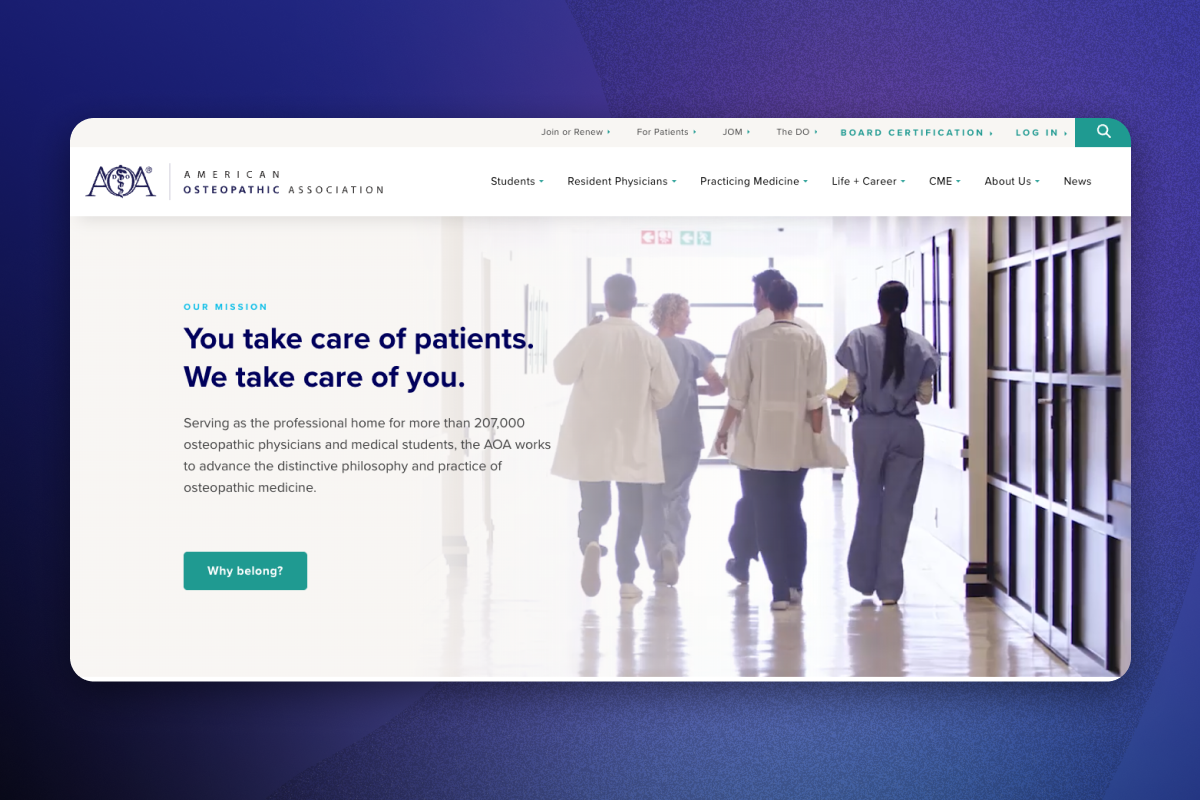
The Work: Consolidated 27 specialty board websites into a single WordPress Multisite platform serving 145,000+ osteopathic physicians and medical students.
Outcome: A unified, user-validated site architecture built from 30+ interviews across seven stakeholder groups - and a 54% lift in conversions on the redesigned member experience.
ABA Student Division (American Bar Association)

The Work: Integrated with Personify using SSO to deliver personalized content experiences.
Outcome: Created custom "Why Join" prompts that trigger based on user profile data, turning the site into a personalized recruitment engine.
AMA Foundation
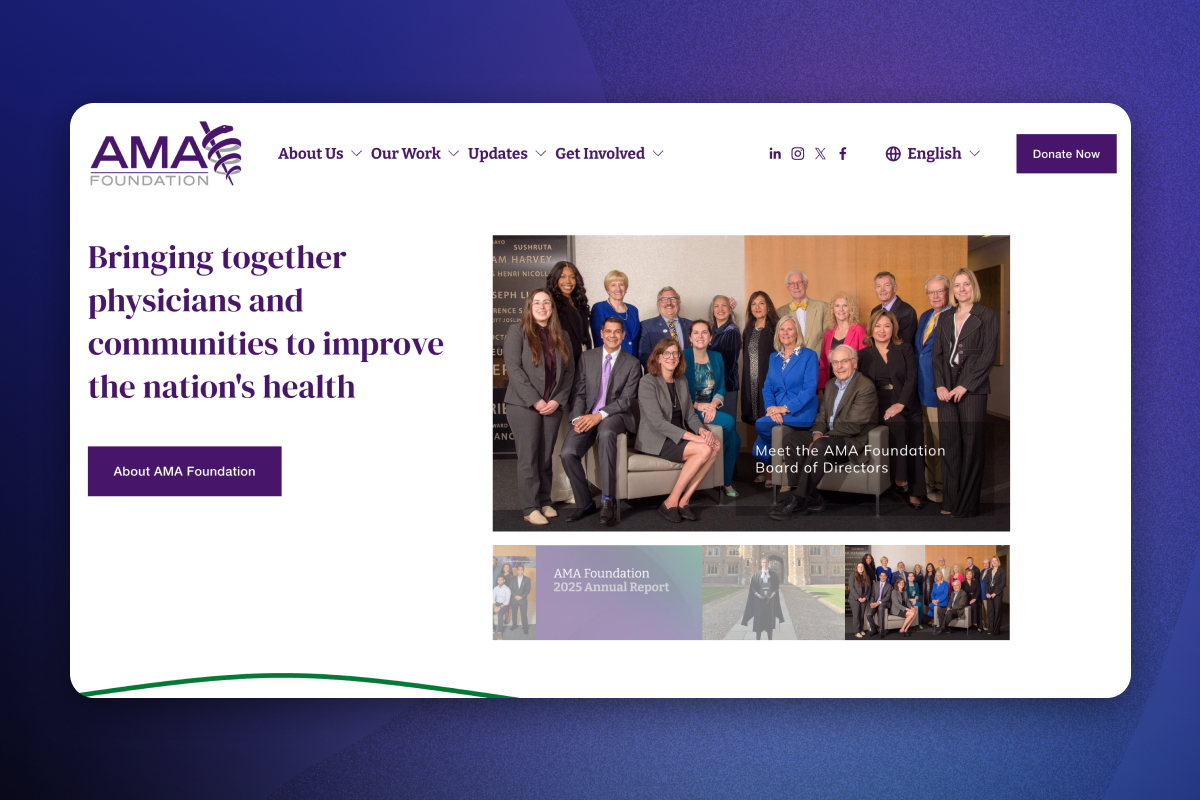
The Work: Built a mobile-first platform separate from AMA's primary site to drive scholarship and mentorship engagement.
Outcome: Increased donor engagement through streamlined conversion paths and responsive storytelling elements.
What makes a great association website?
Key Takeaways: A great association website functions as a member benefit rather than a digital brochure, surfacing membership value in every interaction from search to checkout. Tight AMS integration is foundational - member data, dues, and CE credits must flow between systems without manual reconciliation by association staff. AI-extractable content formats also matter, turning institutional research libraries into discoverable industry standards that engines like ChatGPT and Perplexity can cite.
In 2026, a great association website has moved far beyond being a digital brochure or a static repository of PDF files. It is now the primary delivery vehicle for your Member Value Proposition. To truly succeed, the site must bridge the gap between institutional authority and modern consumer expectations. This means prioritizing Member Experience (MX) - a specialized evolution of UX that recognizes the long-term, high-intent relationship a member has with their organization. A great site acts as a digital headquarters where the value of membership is visible in every interaction. Discovering a niche research paper, completing a certification path, registering for an event - each should feel like a benefit of membership rather than a chore.
Beyond aesthetics, greatness is defined by technical interoperability. Because associations manage vast ecosystems of data, a great site functions as a connective layer on top of fragmented legacy systems. It doesn't just display information; it integrates it. Whether it is a real-time Salesforce sync that updates member tiers instantly or an AI-powered Algolia search that scans decades of archival industry standards, the site must behave like a performance engine. At Clique, we refer to this as Experience Engineering - the process of ensuring your deep industry knowledge is as accessible as it is authoritative, turning your digital presence into your organization's most powerful tool for recruitment and long-term retention.
UX & Navigation: Engineering Smooth Member Journeys
Role-Based Progressive Disclosure: We design interfaces that adapt to the user's specific member intent. By serving content based on whether the user is a prospective member, a legacy professional, or a student, we reduce cognitive load and prevent "choice paralysis."
The zero-UI shortcut: We integrate conversational search and voice-ready navigation cues, allowing members to find certification data or renewal dates through natural language rather than deep-menu diving.
Content Strategy: The Answer Engine Foundation
Entity-First Architecture: We don't just write for keywords; we build for entities. By defining clear relationships between your association, your industry standards, and your expert contributors, we help LLMs recognize you as a primary source of truth.
BLUF (Bottom Line Up Front) Formatting: To capture AI answer box real estate, we structure high-value content-like industry rates or ethics guidelines-with direct, summary-first answers followed by deep-dive technical data.
Semantic Content Clustering: We organize vast legacy libraries into topic pillars. This strategy signals institutional authority to search engines and provides members with a curated path through decades of research.
Conversion Strategy: Optimizing for the Member Lifecycle
Micro-Moment Personalization: We use real-time data from your AMS (Salesforce/Personify) to trigger hyper-relevant CTAs. A member nearing expiration sees a "Renewal" prompt, while a first-time visitor sees a "Value of Membership" narrative.
High-Trust Social Proofing: We place specific case study highlights and industry certifications at "hesitation points" in the application flow to reduce friction and build institutional trust.
Streamlined Transactional Portals: By reducing form fields to the absolute essentials, we eliminate the technical barriers that lead to cart abandonment during dues payment or event registration.
Technical Performance: Stability in a Multi-System Ecosystem
Core Web Vital Excellence: We optimize for the highest standards of Largest Contentful Paint (LCP) and Cumulative Layout Shift (CLS), ensuring your site is fast and stable across all 2026 mobile devices.
Resilient API Mapping: We engineer "fail-safe" integrations. If your AMS or third-party database experiences a lag, your website remains functional, ensuring members never lose access to their primary digital headquarters.
Advanced AI Search (Algolia): We replace standard search with AI-powered federated search that scans your website, document library, and member database simultaneously to provide instant, type-ahead results.
SEO + AEO Readiness: Becoming the chosen source
Comprehensive Schema Markup: We apply Organization, FAQ, and Article schema to every page, providing a machine-readable map that tells AI engines exactly what information to extract and credit to your brand.
Predictive Intent Matching: By analyzing emerging industry search trends, we build content that anticipates the questions your members will ask six months from now, securing your spot as the definitive answer engine.
Authoritative E-E-A-T Signaling: We build "Expert Profiles" for your contributors, linking their credentials across the web to reinforce your association's Experience, Expertise, Authoritativeness, and Trustworthiness.
What features should an association website include?
Key Takeaways: Association website features must move past static utilities like member directories and event calendars into a connected ecosystem with SSO, predictive dashboards, and AI search. Association websites should include real-time AMS data loops that feed information back into Salesforce or Personify, not one-way display interfaces that strand data. Feature interoperability matters more than feature count, because broken SSO between the website, LMS, and forums creates friction no individual feature can fix.
In 2026, the "feature list" of an association website has evolved from a collection of static utilities into a dynamic ecosystem of member-centric capabilities. It is no longer enough to simply host a member directory or a basic event calendar; these features must now act as the digital connective tissue of your professional community. A high-performing feature is one that anticipates a member's need-whether that's a one-click renewal path, an AI-curated resource library, or a personalized networking portal that feels as intuitive as a consumer app. We view these not as "add-ons," but as the fundamental building blocks of your organization's digital value proposition.
The real power of these features, however, lies in their interoperability. For a feature to be successful, it must be "Experience Engineered" to communicate cleanly with your core systems, such as your AMS or CRM. A "login" feature becomes a point of friction if it doesn't offer a unified Single Sign-On (SSO) experience across your LMS and community forums. At Clique, we prioritize features that serve a dual purpose: providing useful, single-step utility to your members while feeding actionable data back into your organization. This ensures your website is not just a destination, but a functional extension of your staff that automates the routine so you can focus on the mission.
To move from a "static site" to a high-performance Experience Engine, your platform should include:
Unified Single Sign-On (SSO): A single-step, "one-and-done" login that creates a unified bridge between your main website, your Learning Management System (LMS), and your community forums.
- Predictive Member Dashboards: A personalized home base that uses AMS data to surface relevant CE credits, upcoming renewals, and suggested content based on the member's professional interest.
- AI-Powered Federated Search: Implementing tools like Algolia to allow members to search across your website, research libraries, and member directories with a single, type-ahead query.
- One-Click Renewal Pathways: Eliminating "checkout friction" by engineering simplified, one-page renewal and registration flows that sync instantly with your Salesforce or Personify database.
- AI-Curated Resource Libraries: A dynamic library that uses machine learning to suggest white papers or standards based on a member's previous search history and role.
- Structured AEO Content Blocks: Content areas architected with Schema markup so your industry standards are easily extracted and cited by AI engines like ChatGPT and Perplexity.
- Modular Design System: A flexible, modular back-end (built in Webflow or WordPress) that allows your staff to launch new initiatives or event pages in hours, not weeks, while remaining 100% on-brand.
- Real-Time Data Loops: Every form and interaction should be designed to feed actionable insights back into your CRM, allowing for more targeted marketing and improved member segmentation.
Related reading from Clique University
More on association and member-organization website strategy from the Clique team:
- How the best association websites are designed to grow and support members - design patterns and structural choices across NYSBA, AMA Foundation, and Union League Club projects.
- 10 association websites that blow us away - annotated examples of member organization sites doing it right.
- 6 surprising ways to increase association membership - beyond the website: the content, community, and feedback patterns that drive retention.
- Custom WordPress development for enterprises and associations - the multisite architecture, SSO, and Core Web Vitals approach behind the AOA build.
Ready to turn your association website into a member benefit?
Whether you're planning an AMS consolidation, an Algolia search rollout, or a full AEO content overhaul, Clique Studios can help. Talk to the team about what a member-first redesign would look like for your association.