How are AEO, Webflow, and AI marketing reshaping the modern website?

How are AEO, Webflow, and AI Marketing Reshaping the Modern Website?
Clique Studios recently co-hosted an event in Chicago with Guy Yalif, Chief Evangelist at Webflow, to dig into one of the biggest shifts happening in digital marketing right now: how brands need to adapt as search, AI, and buyer behavior continue to change.
Guy brought the perspective of someone who has spent decades in martech and conversion optimization, including as co-founder and CEO of Intellimize, the optimization platform Webflow acquired after an extensive evaluation process. The result was a conversation grounded in real experience, practical insight, and the kind of strategic questions marketers and business leaders are actively trying to answer right now.
For teams thinking about AEO, SEO, AI marketing, website strategy, and personalization, the message was clear: the fundamentals still matter, but the way we apply them is evolving fast.
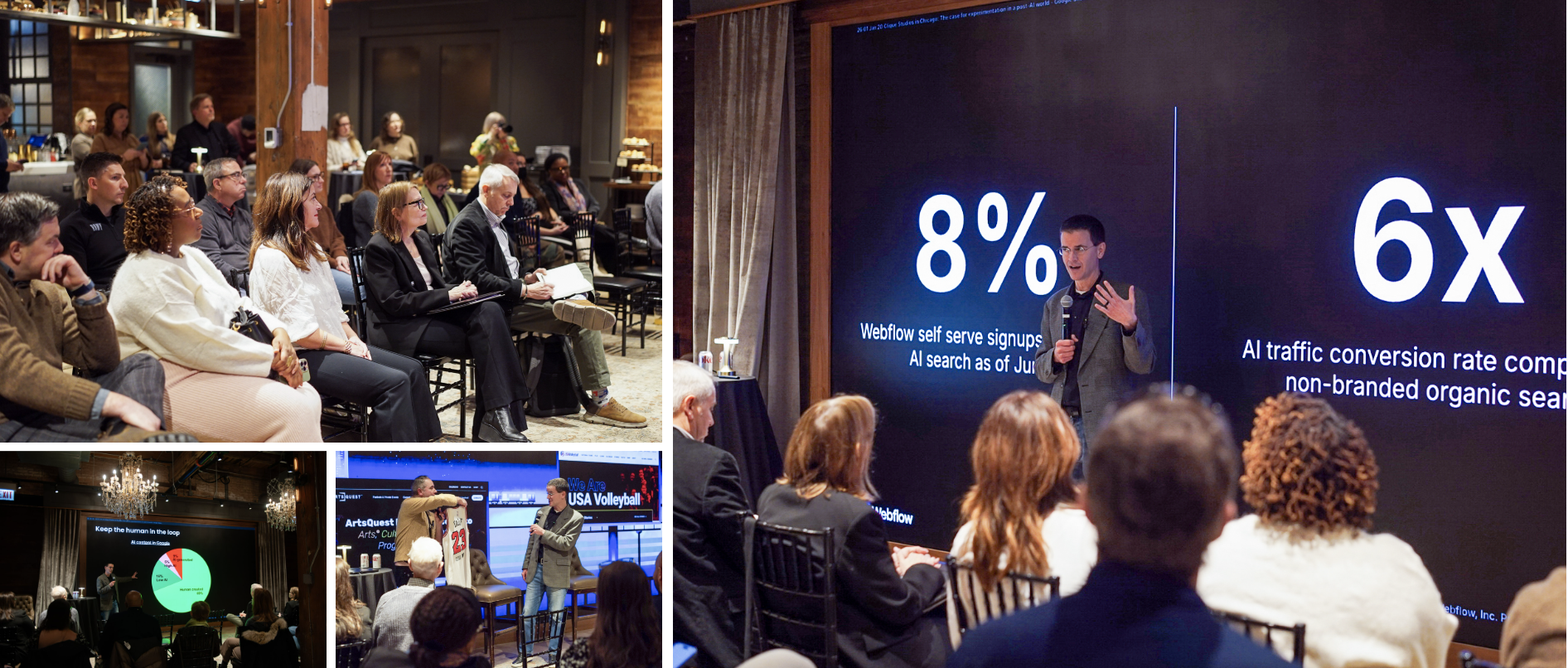
A conversation about what’s changing in marketing
Clique Studios recently welcomed Webflow Chief Evangelist Guy Yalif to Chicago for a live conversation on AEO, SEO, AI marketing, and website optimization.
It was a practical discussion about how organizations should think about content, technical structure, authority, measurement, and personalization as AI becomes a more meaningful part of how people discover brands online.
What made the session especially valuable was that it combined market perspective with firsthand experience. Guy shared what Webflow is seeing across the industry, along with lessons from Webflow’s own testing and optimization efforts. Ted Novak connected those ideas to the real decisions marketing teams and business owners are trying to make every day: where to start, what to prioritize, and how to adopt AI without losing the human side of marketing.
Key takeaways from the event
1. AEO builds on SEO. It doesn’t replace it.
One of the biggest points from the session was that AEO should not be treated like a full reset. Strong SEO fundamentals still matter. In many cases, the teams best prepared for AEO are the same teams already doing thoughtful SEO work today.
The difference is that organizations now need to think beyond rankings and keywords alone. They need content that answers real questions, pages that are easy for machines to interpret, and a stronger understanding of how their brand shows up inside AI-driven discovery.
“Your SEO team is your AEO team.” - Guy Yalif
2. AI-referred traffic may be smaller, but it can be more qualified
Guy shared that while many brands are seeing some traditional traffic soften, AI-referred traffic is growing and often converting at a much higher rate. That matters because it shifts the conversation from volume alone to quality and intent.
For marketers, this reinforces the importance of building websites that do more than attract visits. The site needs to be ready to educate, build trust, and guide the next step when a more qualified visitor shows up.
3. The content opportunity is in answering better questions
A major theme throughout the event was that organizations should start treating their content strategy less like a keyword map and more like a structured system for answering audience questions.
That means looking closely at what comes up in sales calls, customer conversations, support requests, and search behavior. Those questions can then become the foundation for stronger website pages, articles, FAQs, and supporting content across the funnel.
“We’re going to shift from being focused on keywords to focusing on answering questions.”— Guy Yalif
4. Technical structure matters more than ever
Schema, page structure, metadata, transcripts, alt text, FAQs, and crawlable HTML all came up as practical ways to make content easier for AI systems and search engines to understand.
This is one of the clearest areas where organizations can take action. If your content is valuable but difficult for machines to interpret, you are creating friction where you do not need to.
“People still read, machines read faster.” - Ted Novak
5. Authority now goes beyond backlinks
Backlinks still matter. But the event also highlighted how AI systems look for repeated proof, consistent positioning, plain-text mentions, and signals of real expertise.
That means authority comes from more than just off-page SEO. It also comes from thought leadership, original research, podcasts, expert bios, interviews, and content that reflects actual experience in the subject matter.
6. Personalization is becoming more dynamic
The conversation also touched on how AI is changing website personalization. Instead of broad message testing alone, teams can increasingly tailor experiences based on audience signals, source, behavior, and intent.
The opportunity is real, but so is the need for process. Better personalization still depends on strong messaging, useful content, clear audience thinking, and disciplined experimentation.
Why this matters for marketers and business leaders
Most organizations are not asking whether AI is important anymore. They are asking how to use it in a way that actually improves their marketing.
That is where this conversation was especially useful.
The path forward is not to throw out SEO, rewrite every process, or flood your site with generic AI-written content. It is to get sharper about what your audience needs, make your expertise easier to understand, and build a website that works better for both humans and machines.
For marketing teams, that often means:
- shifting content planning toward real audience questions
- improving page structure and structured data
- updating content more often
- making expertise more visible
- using AI to accelerate testing, analysis, and optimization
- treating the website as an active part of brand building and revenue generation
For business leaders, it means the website has become even more strategic. It is no longer just a destination for traffic. It is part of how your company gets understood, evaluated, and remembered.
"Your website still remains the only place you can fully own your narrative." - Ted Novak
What organizations should take away from this
AEO is a process shift
The organizations that will get the most from AEO are not the ones chasing shortcuts. They are the ones building repeatable ways to identify customer questions, create stronger answers, structure content clearly, and keep their websites current.
Website strategy is becoming more connected to revenue strategy
As traffic sources evolve and AI-referred visits become more qualified, the website plays a bigger role in helping buyers understand your value and move forward with confidence.
Human judgment still matters
AI can accelerate a lot. It can support research, content production, testing, and personalization. But the strongest brands will still be the ones with clear thinking, strong points of view, and content that actually helps people make decisions.
Technical execution supports visibility
AEO is not only a messaging challenge. It is also a technical one. The brands that make their content easier to interpret will be in a better position to earn visibility in both search engines and answer engines.
Final thoughts
What stood out most from this event was how connected all of these topics really are.
AEO is not separate from SEO. AI marketing is not separate from website strategy. Personalization is not separate from content. For modern marketing teams, these are all parts of the same system.
That is why this conversation mattered.
It gave marketers and business leaders a more grounded way to think about what comes next: build a better content operation, build a better website foundation, and use AI in ways that make both of those systems stronger.